

If your lawn sits on typical Rockwall County soil, it sits on blackland prairie clay, and clay has a habit that works against grass: it compacts. Kids, dogs, mowers, and a baking summer press those fine particles together until water sheets off instead of soaking in and roots run out of air. Core aeration is the fix, and around here the timing matters as much as the work.
Why Clay Compaction Chokes Roots
Healthy soil is roughly half pore space, little channels that hold air and water. Compacted clay loses those channels. Water puddles or runs off, oxygen cannot reach the root zone, and the grass responds by growing shallow roots that suffer first in July. You can test your own yard with a screwdriver: a day after watering, it should slide 4 to 6 inches into the soil without a fight. If you have to lean on it, the lawn is telling you something.
What Core Aeration Actually Does
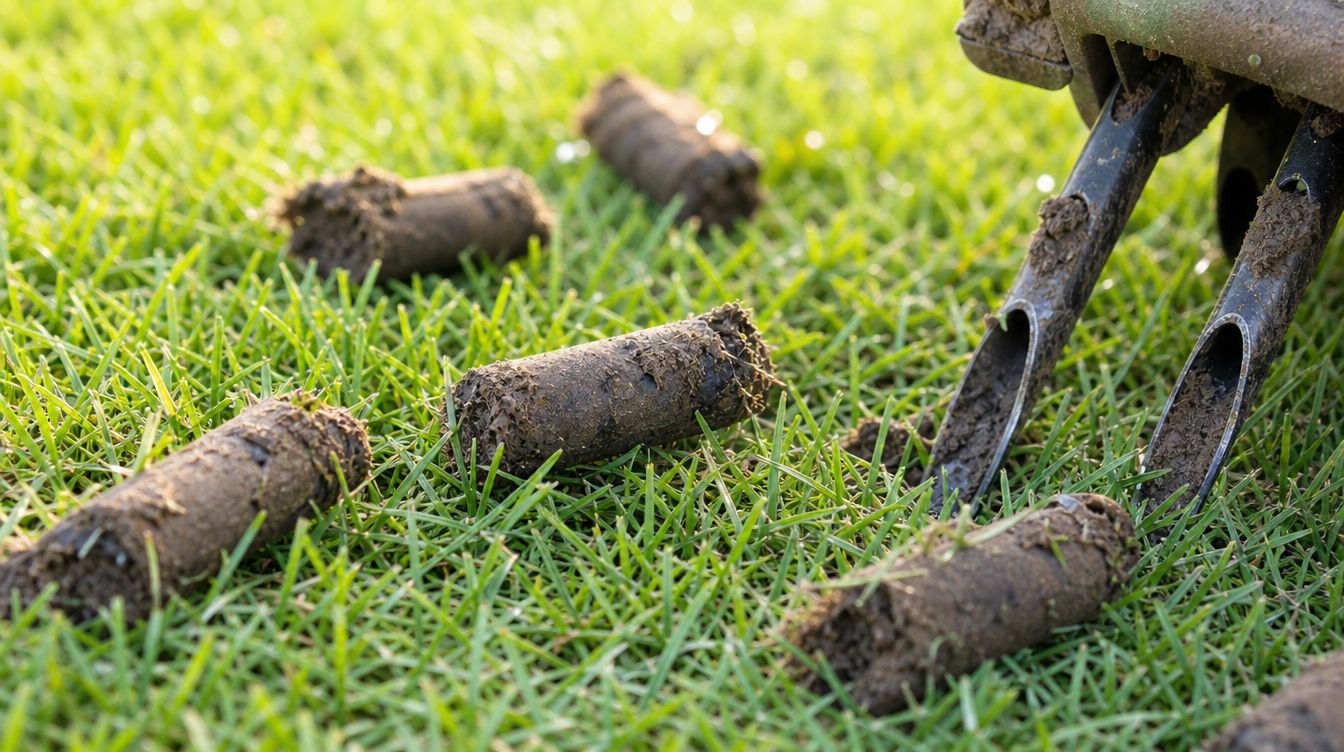
A core aerator pulls thousands of plugs, each about the size of your finger, 2 to 3 inches deep, and drops them on the surface. Every hole is a channel where water, air, and fertilizer reach the roots directly, and the loosened soil around each hole gives roots somewhere to grow. Leave the plugs where they land. They look rough for a week or two, then rain and mowing crumble them back in, returning soil microbes to the thatch layer while they are at it. Spike aerators, the ones that just poke holes without removing anything, mostly squeeze clay tighter and are not worth the pass. One pass with a real core machine pulls a plug every few inches. If your clay is badly compacted, a second pass in a different direction doubles the channels for very little extra effort.
The Right Window for Warm-Season Grass
Bermuda, St. Augustine, and zoysia should be aerated when they are growing at full speed, so they refill the holes with new roots fast. In North Texas that means late April through June, once the lawn is fully green and you are mowing weekly. Aerating dormant or half-awake turf in February just tears it up with nothing gained, and aerating in the stress of late August asks a tired lawn to heal in the worst heat of the year.
Two small prep notes: water the lawn a day ahead so the tines can bite into the clay, and flag your sprinkler heads so the machine does not find them for you. Expect the lawn to look a little ragged for a week, then noticeably better within a month as roots move into the opened soil.
Pair It With a Feeding
Aeration and fertilization are a natural pair. Fertilizer applied right after aeration falls into open channels instead of sitting on a sealed surface, which is exactly where you want it. If you applied a spring pre-emergent, the research is reassuring: core aeration disturbs that chemical barrier far less than people fear. Still, if you want to be conservative, aerating a few weeks after the application costs you nothing. Aeration also helps the thatch layer, that mat of dead stems between the grass and the soil, break down faster, which matters on older bermuda lawns where thatch can get thick enough to shed water on its own.
Once a year is plenty for most lawns, and lawns with heavy traffic or serious runoff benefit the most. Milliken's runs core aeration across Rockwall County every spring, timed to the growth window, so the holes heal quick and the roots get the full benefit.
